

Running a Shopify store comes with countless support tickets, from shipping delays to return requests and product questions. As your store grows, your support team can’t keep up. That’s where AI customer support agents come in.
In this list, we break down the top 8 AI agents and support chatbots for Shopify so you can pick the best solution for your business. It is the Shopify drill-down of our wider guide to the best AI chatbots for e-commerce: platform-agnostic tools live there, and the Shopify-specific picture lives here. One of the eight (Engaige) is ours, so we show our working: the methodology below applies to us too.
How is this list created?
This list is generated based on the Shopify integration each tool provides. The inclusion rule: a tool must offer a genuine Shopify integration, as a native app or a documented API connection, and a tool that does not publish its Shopify integration is left out. Integration depth, how far that integration lets the AI act (from reading order data, to processing refunds and cancellations, to editing subscriptions), then carries the joint-heaviest weight in the six-criterion matrix that orders this list. Depth matters most, but it does not decide the ranking alone.
One test for every number you’ll see, ours included: which named customer produced it, over what period, and what does the vendor count as “resolved”? A rate with none of those attached is a marketing figure, not a benchmark. Resolution figures below are vendor-stated unless noted, and how well a vendor substantiates its own claims counts toward its transparency score.
What to look for in a Shopify AI agent or support chatbot
If you’re scaling your Shopify support team and looking to automate tickets with AI, here’s what to look for in an AI agent:
Deep Shopify & helpdesk integrations
A great AI agent connects directly to your Shopify store and helpdesk so it can pull order details automatically and update tickets in real time. For example, when a customer asks “Where’s my order?”, the agent can instantly check Shopify for tracking info and share it, no manual lookup required.
But it’s not just about fetching a tracking link. Many WISMO (Where Is My Order) tickets come in because the shipping status is confusing or incorrect. Customers might see updates that don’t make sense, or think their package is lost. By using real-time order and tracking data, an AI agent can help clarify these issues on the spot, reduce unnecessary back-and-forth, and give customers accurate, reassuring answers right away.
Ability to take actions (not just suggest replies)
Unlike simple chatbots that only suggest text, the best AI agents can actually take actions in your Shopify store, like processing refunds, cancelling orders, or updating shipping details. This is important because customers asking about their order status often don’t just want information, they want to resolve a problem. If the tracking info is wrong or unclear, they may want a refund or request a replacement instead.
Imagine a customer who wants to cancel an order they just placed: the AI can handle the cancellation immediately, before it ships. Or if the shipment is stuck or lost, the agent can process a refund or issue a replacement without needing your team to step in. By automating these routine yet important tasks, you reduce back-and-forth emails and help customers get what they want quickly, freeing up your team to focus on more complex issues.
Trained on your business policies
Your AI agent should understand your unique return windows, shipping rules, and discount policies so it always gives accurate, on-brand responses. For example, if you have a 30-day return policy on shoes but final sale on accessories, the AI will know not to promise a refund where it isn’t allowed. By being trained on your policies, it helps avoid misunderstandings, reduces escalations, and makes sure customers always get consistent, reliable answers.
Context-aware: sees orders, history, and knows your tone of voice
A context-aware AI agent doesn’t just see the latest message, it has visibility into the customer’s entire order history and past support interactions. If someone writes in about a missing item, it can check their recent orders and see that part of the shipment went separately, then respond with: “Hi Emma, I see your shirt shipped separately on July 2nd. Here’s the tracking link.”
It’s not just about knowing the facts, it’s about delivering answers in a tone that feels human, friendly, and aligned with how your support team would naturally respond. This level of customer service responses makes your support feel human, not robotic.
Proven ROI through reasoning, ticket deflection & resolution
One of the biggest benefits of a strong AI agent is its ability to deflect and resolve the repetitive tickets that take up most of your team’s time, like “Where’s my order?” or “How do I return this?”. But ROI isn’t just about automation, it’s about reasoning. A good AI agent can understand what your customer is really asking, apply your policies and context, and choose the right next step automatically.
By combining this reasoning ability with automation, you can deliver fast, accurate resolutions, reduce manual workload, and let your team focus on more complex or high-value conversations.
That expectation matches what Shopify operators report in practice when the integration is set up properly:
February 2026 Reddit For support, chatbots are great at handling the repeat stuff: shipping times, returns, order status, sizing questions. When it's set up properly, it can handle 60–70% of tickets and free up your team for the complicated or high-value cases. · r/shopify View on RedditWhat’s the difference between a chatbot and an AI agent for a Shopify store?
Now that you know what to look for in an AI agent, it’s also important to understand how these differ from basic chatbots. People use “chatbot” and “AI agent” interchangeably across AI customer support, but for a busy Shopify store the difference decides how many tickets actually disappear.
A basic chatbot is usually rule-based or keyword-triggered
It follows simple scripts to answer FAQs like “What are your opening hours?” or “Do you ship internationally?”. These bots are limited because they can’t understand customer context or take meaningful action in your Shopify store. If a customer asks to cancel an order or check delivery status, the chatbot typically says: “Please wait for an agent” or gives them a link to your help page.
Pros and cons:
- Cheap and easy to set up
- Good for very simple FAQs
- Can’t access Shopify data or perform actions
- Often frustrate customers with dead ends (“Please email us”)
An AI agent is designed to automate support tasks, not just answer questions
It connects directly to your Shopify store and helpdesk, so it can check real-time order data, process refunds, cancel orders, update addresses, or even create discount codes on the fly. For example, if a customer messages: “Can I cancel order #1234?”, the AI agent can check if it’s unfulfilled and cancel it immediately, updating the customer without any human intervention.
Pros and cons:
- Can handle real support tasks end-to-end
- Personalised responses with real order data
- Reduces workload for your team by solving issues automatically
- Slightly more complex to implement (needs integrations and training)
When evaluating customer service tools (like the ones on this list), you’ll often see both types marketed as “chatbots,” so it’s important to look carefully at what they actually do. A true AI agent for Shopify should be able to integrate with your store, understand your policies, and take action on behalf of your support team. That’s how you bring a better experience for your customers while making life easier for your support team.
How deep does each tool act inside Shopify?
Before the list, here is the qualifying axis in one picture. Depth measures how far each tool’s integration lets the AI act in your store, from reading order data (shallow) to autonomously processing refunds, cancellations and subscription changes (deep). Gorgias, the Shopify-native helpdesk, leads this axis; the overall ranking below also weighs resolution, pricing and transparency.
Depth measures how far the AI can act per the vendor’s own documentation, not the number of integrations. Source: public documentation + our own analysis, June 2026.
The list: top 8 AI agents and support chatbots for Shopify (2026)
Alright, enough with the theory. It’s time to take a closer look at the different AI agents and support chatbots. The entries follow the weighted ranking from the score matrix further down. What exactly does each tool do inside Shopify, how do they differ, and what’s the best use case for each? Let’s find out below.
1. Engaige
letsengaige.com (that’s us!)
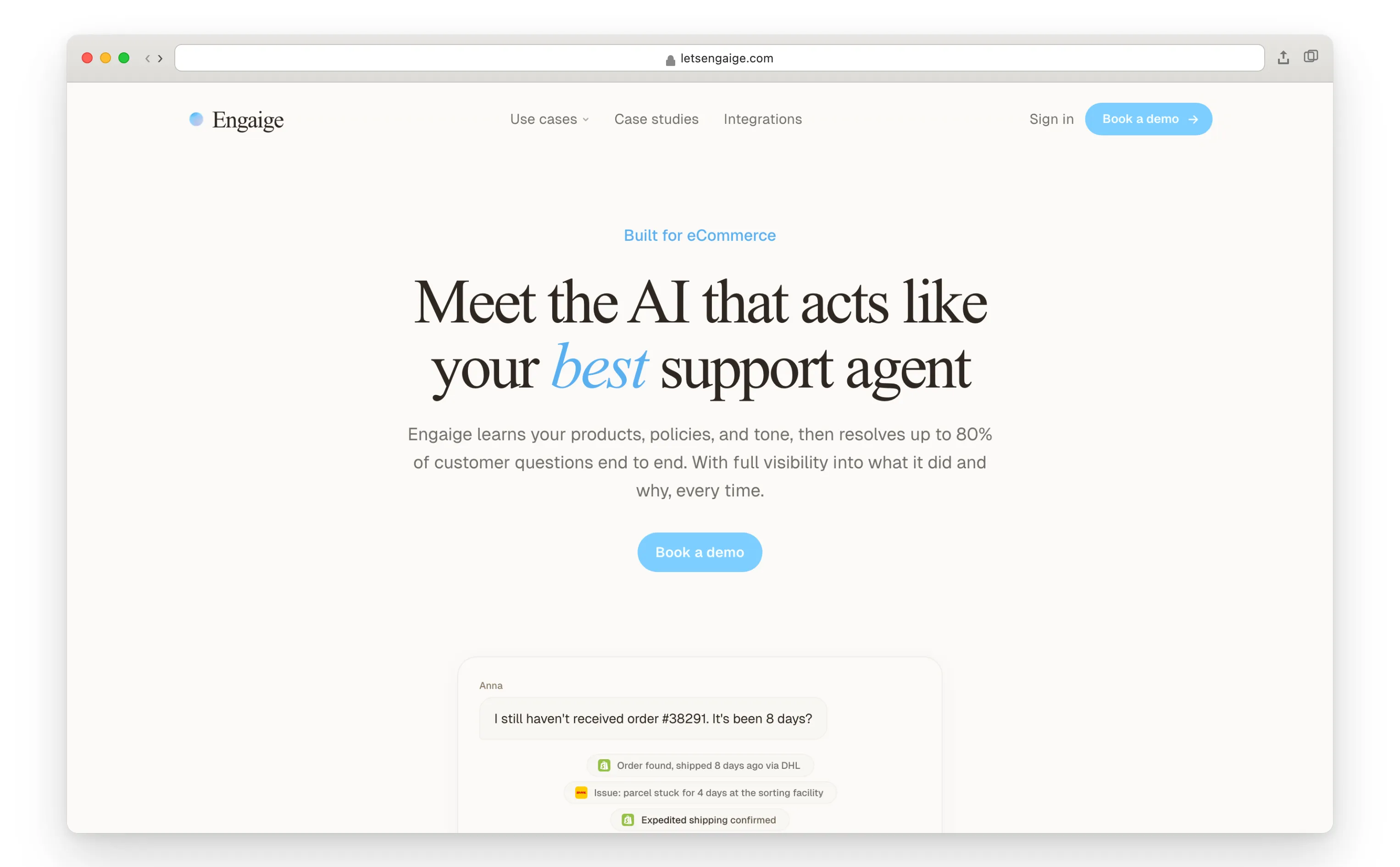
Engaige is an AI agent for customer service built for Shopify support teams in industries like fashion, beauty, and electronics. It doesn’t just respond to tickets: it resolves them end-to-end by understanding your products, policies, and workflows, instructed in plain language through an AI Manager.
The verified outcomes, with the case studies open for inspection: Otrium resolves 65% of 120,000 annual tickets autonomously, and HelloPrint automated 70% of support, cut first-response time by 90%, and shrank its team from 100 to 28. The “up to 80%” we state is our ceiling at the deepest integrations, the same kind of vendor-stated ceiling you should challenge every supplier on.
Inside Shopify it can: read orders, products and customer history in real time; process returns and refunds per your policy; change addresses; handle warranty claims; manage subscription changes.
Key features:
- AI agent trained on your company’s policies, in plain language (no prompt engineers)
- Fully integrated with Shopify, Mollie, UPS & more
- AI agent integrated with your product catalogue
- Automates conversations via email, chat and social
- You can test and preview your AI agent outputs before they go live
Pros
- Resolves the repetitive middle end to end: named outcomes of 65% (Otrium) and 70% (HelloPrint), with up to 80% as our stated ceiling
- Full control and transparency over AI behaviour
- Flat monthly pricing to a ticket volume, so the bill stays predictable as you scale
Cons
- Needs an initial training phase on your policies, so it ramps over weeks rather than launching same-day
Best for: Shopify stores in fashion, beauty and consumer electronics looking to scale customer service with deep automation.
Engaige offered control, flexibility, and the ability to really incorporate AI in a more human way.

2. Gorgias

Gorgias is the Shopify-native e-commerce helpdesk, and on raw Shopify integration depth it leads this list. Its AI Agent has moved well past suggested replies: it now takes real actions, editing subscriptions, issuing refunds and updating shipping details, and Gorgias states “60% of inquiries resolved instantly” (vendor-stated). See our Gorgias vs Zendesk comparison for the full picture.
Inside Shopify it can: view and edit orders natively; issue refunds; update shipping details; edit subscriptions via ReCharge and Loop; surface live product and inventory data for recommendations.
Key features:
- The deepest native Shopify integration in this list
- Multichannel inbox combining email, chat, and social in one platform
- Robust macros for agent productivity and consistent responses
- AI Agent that acts autonomously on orders, refunds and subscriptions
Pros
- Built specifically for Shopify, with order actions native to the helpdesk
- Strong helpdesk features and ecosystem
- AI Agent genuinely resolves, not just suggests
Cons
- Per-resolution pricing on top of the seat plan, so a resolved ticket can cost the seat fee plus the resolution fee
- Independent reviews report real per-merchant rates well below the 60% headline
Best for: Shopify brands that want one helpdesk with native order actions and are comfortable with per-resolution pricing.
3. Yuma
Yuma is an autonomous AI agent purpose-built for Shopify that sits inside your existing helpdesk (Gorgias, Zendesk, Kustomer, Re:amaze and more) and resolves tickets end to end. To its credit, Yuma publishes per-customer rates rather than one headline: 89% at EvryJewels, 70% at Clove, 64% at Tediber, down to roughly 40% in the first days elsewhere (all vendor-stated).
Inside Shopify it can: take real actions through your helpdesk and Shopify: process refunds, create labels, edit subscriptions (Recharge, Loop, Skio), and read order, shipping and payment context.
Key features:
- Purpose-built for Shopify, layered on your existing helpdesk
- Autonomous actions: refunds, label creation, subscription edits
- Wide ecosystem: Recharge, Loop, Klaviyo, ShipStation and 25+ more
- Publishes per-customer automation rates, including unflattering ones
Pros
- Keep your current helpdesk and upgrade only the AI on top
- Genuinely autonomous on the repetitive middle
- Unusually transparent about real customer outcomes
Cons
- Quote-based pricing, not public
- How deeply it can act depends on the underlying helpdesk and your integrations
Best for: Shopify brands happy with their helpdesk that want to add genuine autonomous resolution on top.
4. Richpanel
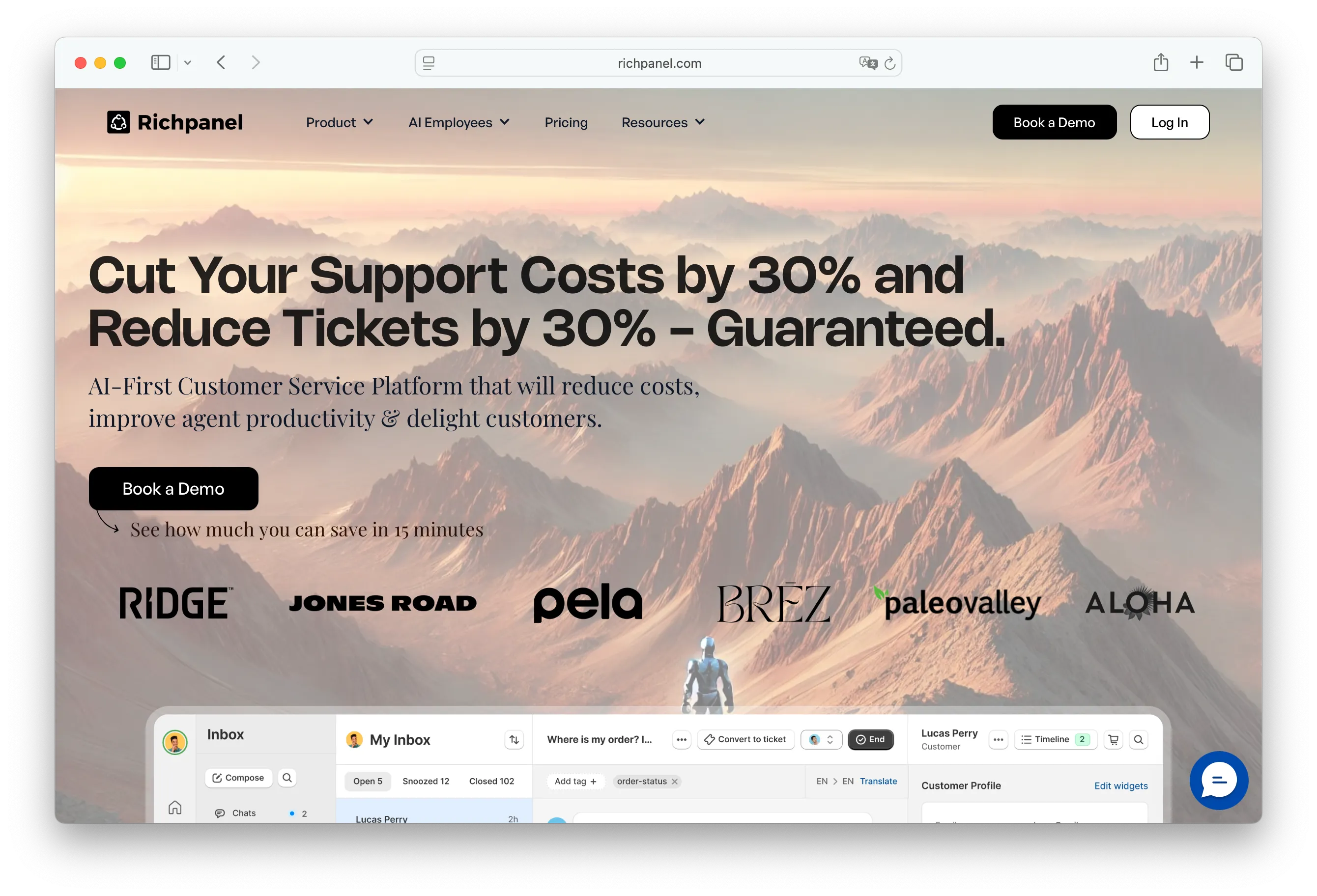
Richpanel has shifted from an assist tool to an autonomous one: its AI agent now resolves refunds, order tracking, subscriptions and cancellations on its own, with your team handling approvals and exceptions. It cites “70-80% resolved autonomously at maturity” and a “50% guaranteed in the first 30 days” (both vendor-stated), with named brands like Ridge, Jones Road Beauty and Shinesty.
Inside Shopify it can: look up and act on orders; process refunds and cancellations; handle subscription changes via Recharge, Loop and Skio; run a branded self-service portal on your store data.
Key features:
- Autonomous AI agent with an approvals workflow for sensitive cases
- Branded self-service portal
- Centralised multichannel inbox
- A guaranteed resolution floor (50% in 30 days), which is rare accountability
Pros
- Genuine autonomous resolution, not just deflection
- The guarantee puts skin in the game
- E-commerce-native order data integrations
Cons
- Deeper value requires adopting the full Richpanel platform
- WooCommerce and Magento support is not named, so confirm beyond Shopify
Best for: Shopify brands that want autonomous resolution with an approvals safety net and a guaranteed floor.
5. Tidio
Tidio is ideal for small and medium businesses that want a quick setup and lightweight AI solution. Its easy-to-use live chat and AI agent, Lyro, focuses on FAQs and simple replies across chat, email, and social channels. Tidio claims a 67% average resolution rate (vendor-stated), backed by a money-back guarantee if Lyro does not reach at least 50%.
Inside Shopify it can: check order status through the Shopify connector; answer product and FAQ questions from your catalogue; take basic actions via connectors, though complex multi-step workflows still escalate.
Key features:
- Quick installation and setup, perfect for small and medium businesses
- Customisable website chat widget to match branding
- Omnichannel inbox for managing chat, email, and social
- Lyro AI for multilingual FAQ answering with a money-back guarantee
Pros
- Easy to set up, fast time-to-value
- Combines live chat and AI chatbot in one platform
- The resolution guarantee is honest accountability at this price point
Cons
- AI is FAQ-strongest; autonomous commerce actions are newer and integration-dependent
- Shallow back-end integrations limit advanced workflows
- Pricing stacks as conversation volume grows
Best for: SMBs needing a simple AI chatbot without deep automation.
6. Shopify Inbox
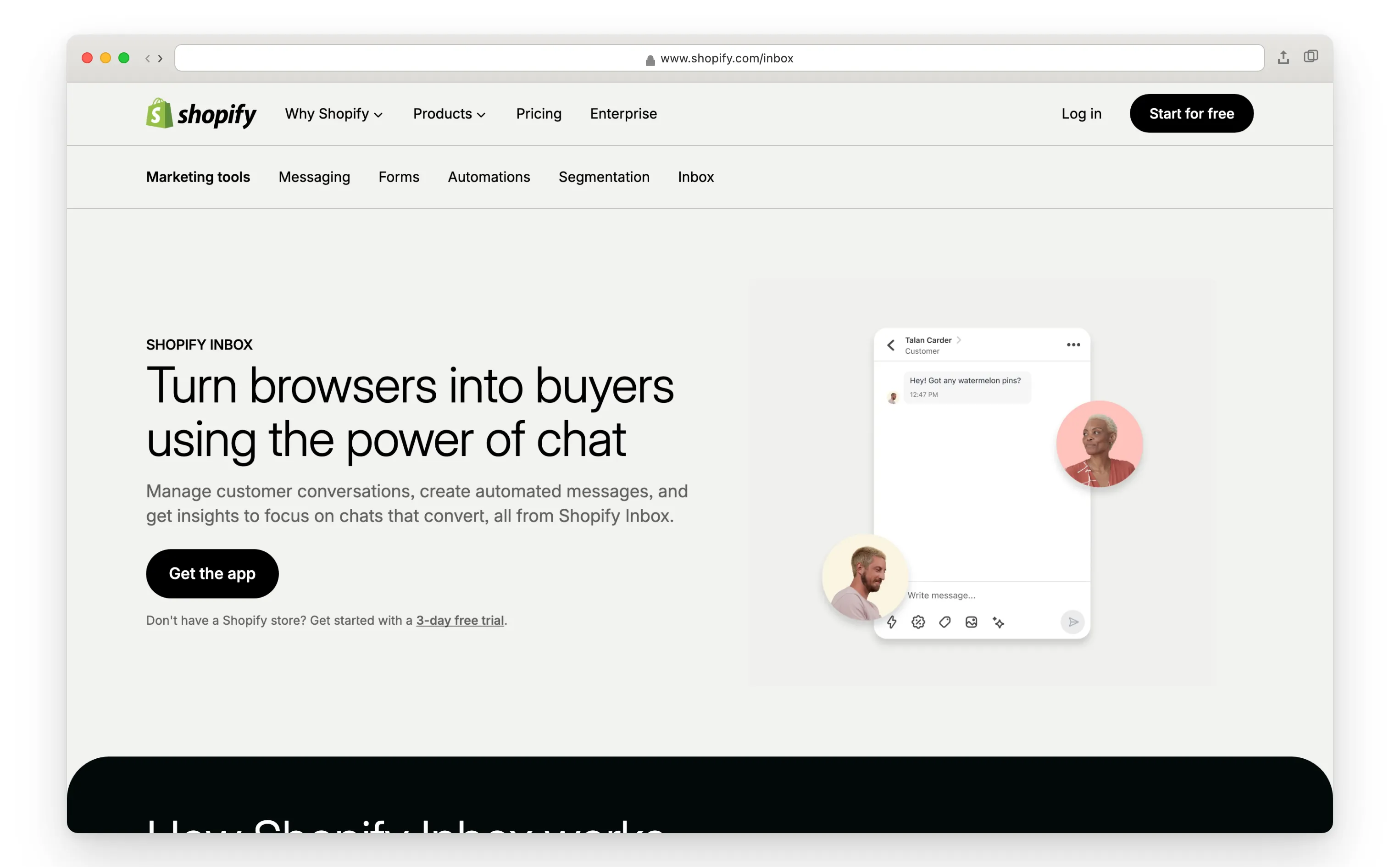
Shopify Inbox is Shopify’s own free chat app, built into the admin, and it is the baseline every merchant should try first. Its AI (Shopify Magic) suggests replies and serves instant answers you review and publish, and Shopify states “70% of Inbox conversations are with customers making a purchasing decision” (vendor-stated). What it does not do is act: no autonomous refunds, cancellations or returns.
Inside Shopify it can: show cart contents and automated order-status updates in chat; suggest AI-drafted replies for you to send; answer published FAQs. Actions stay manual.
Key features:
- Free, native, and installed in minutes from your admin
- Shopify Magic suggested replies and instant answers
- Cart insights during live chat
- Automated order status updates in chat
Pros
- Free, so the ROI bar is on the floor
- Native by definition: zero integration work
- Good fit for pre-sales questions, where most of its conversations happen
Cons
- The AI suggests and answers; it does not resolve or take actions
- Chat-only: no email, social or multichannel inbox
- You (or your team) still send every reply and perform every action
Best for: New and small Shopify stores that want a free chat baseline before investing in automation.
7. Re:amaze
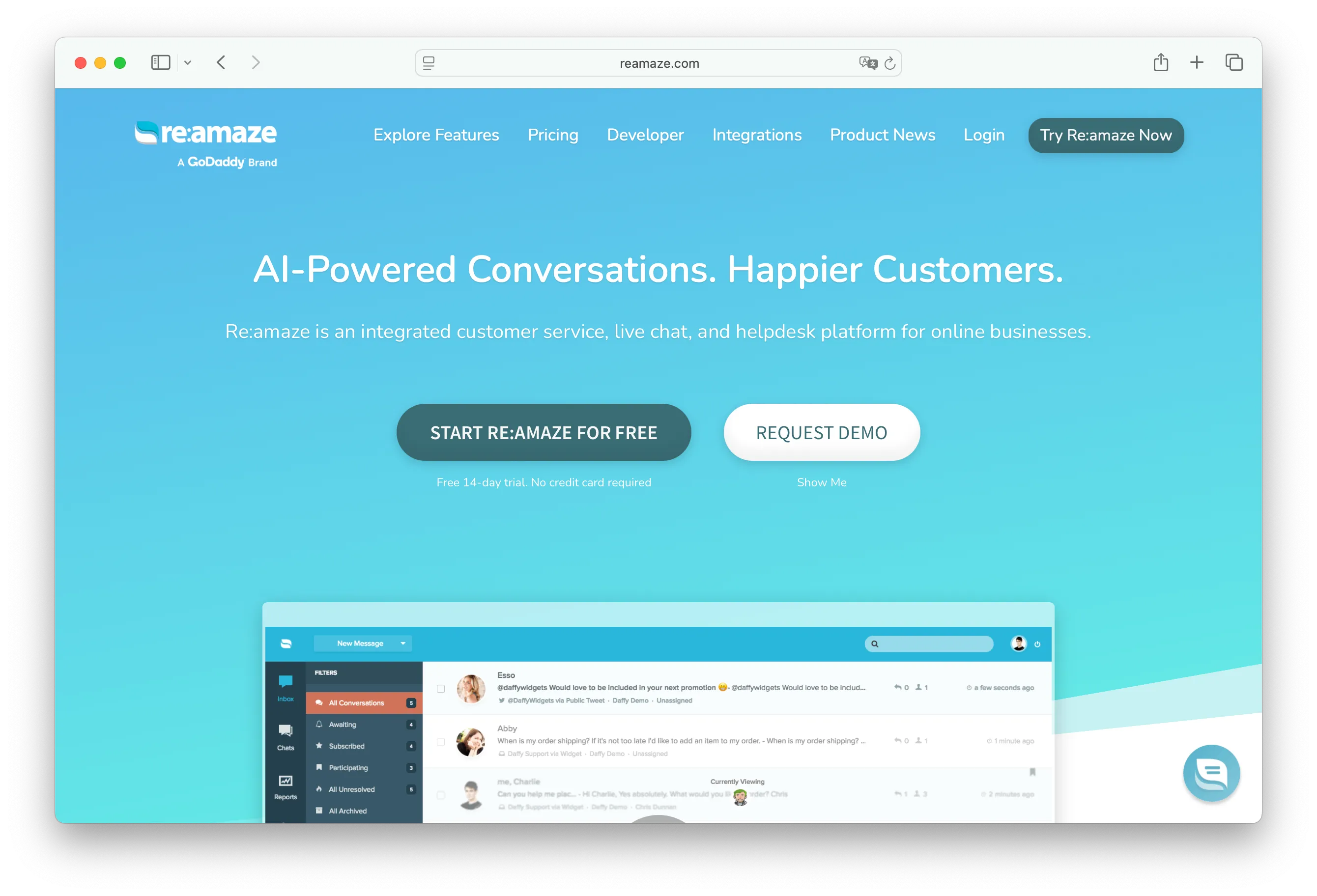
Re:amaze is a multichannel e-commerce helpdesk that brings email, live chat, and social into one inbox, with AI that pre-drafts replies and summarises conversations rather than resolving autonomously. Its pre-built bots (Hello, FAQ, Order) automate common questions and order lookups, and pricing is flat tiers, which is friendly for smaller teams.
Inside Shopify it can: let agents view, create and edit orders from the dashboard; run an order-lookup bot for customers; draft replies with AI. Autonomous actions are not part of the offer.
Key features:
- Unified inbox across email, live chat, social, SMS, and voice channels
- Native e-commerce integrations (Shopify, BigCommerce) with in-chat order editing for agents
- Three pre-built chatbots (Hello, FAQ, Order) for common questions and lookups
Pros
- Multichannel inbox to handle every support channel in one place
- Agents can create or edit orders right inside the chat interface
- Flat-tier pricing stays predictable
Cons
- AI is assistive, not action-based: most issues still need a human
- Focuses on agent productivity and self-service, not autonomous resolution
Best for: Teams that want AI assist across many channels, not full automation.
8. Zendesk
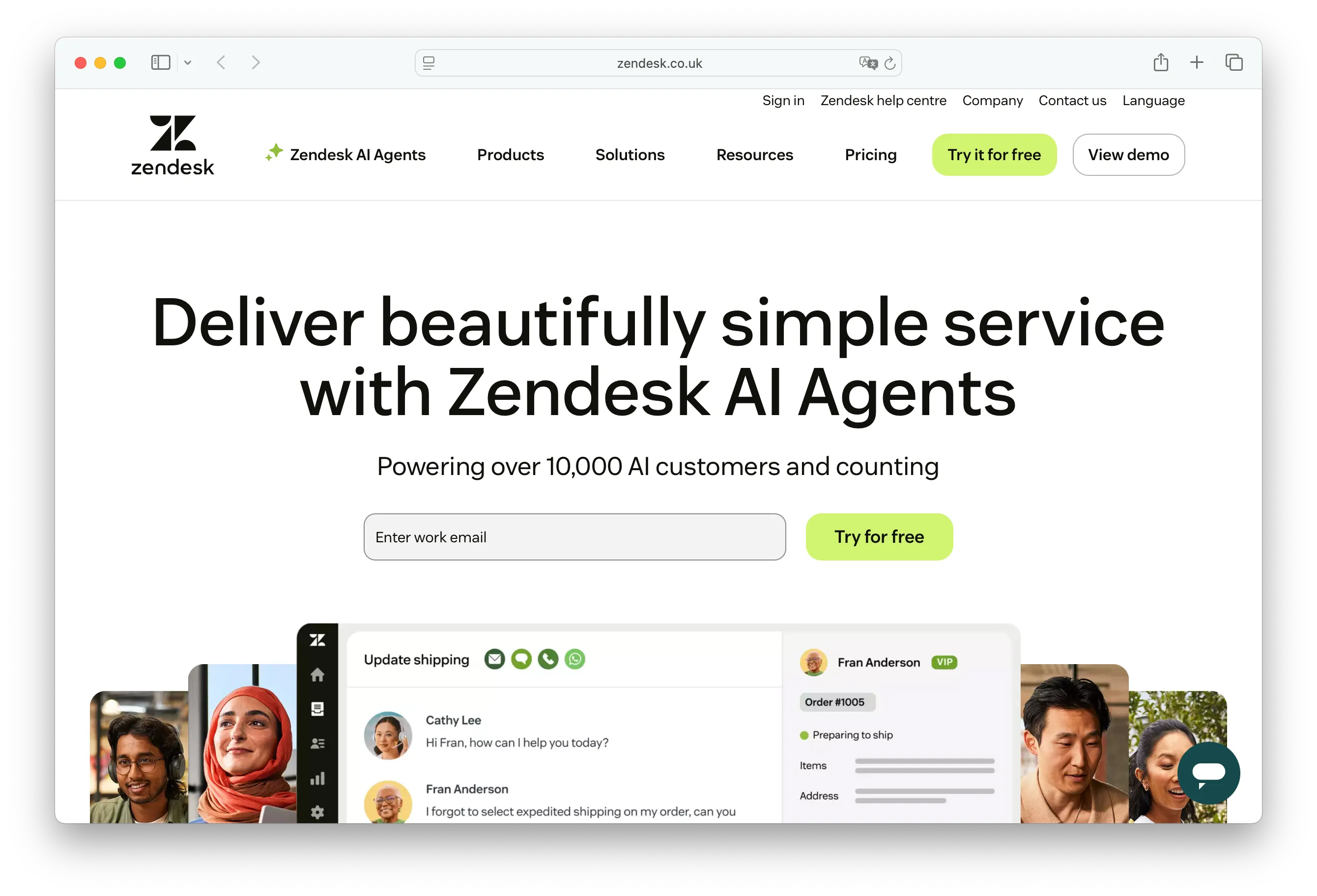
Zendesk is the enterprise-grade option, repositioned in 2026 as a “Resolution Platform” whose agents it states “routinely resolve over 80% of interactions” (vendor-stated). The catch on this list is the axis: its Shopify app surfaces order context in tickets, but autonomous commerce actions (refunds, order edits) require custom middleware rather than coming native, which is why it ranks low here despite strong horizontal AI.
Inside Shopify it can: display order and customer context next to tickets via the Shopify app; route and triage commerce tickets. Autonomous Shopify actions need custom build work.
Key features:
- Omnichannel ticketing system that works out of the box for email, chat, and social
- Advanced SLAs, routing rules, and analytics to manage complex operations
- 1,500+ marketplace integrations
- Autonomous AI agents, billed per verified resolution
Pros
- Omnichannel support across all major customer contact points
- Advanced SLA management and analytics for professional operations
- Strong AI transparency and QA tooling
Cons
- Not Shopify-native: deep commerce actions require middleware or custom work
- Seats plus AI add-ons plus per-resolution fees add up quickly
- Heavy for small and midsize Shopify teams
Best for: Enterprise teams managing high ticket volumes with complex workflows across more than just Shopify.
Comparison of the best AI agents and support chatbots for Shopify stores
| Tool | Best for | Inside Shopify it can | Automation level | Key limitation |
|---|---|---|---|---|
| Engaige | Automating support at scale | Read orders/catalogue, refunds, returns, address changes, warranties | End-to-end resolution (verified 65-70%, up to 80%) | Initial policy-training phase |
| Gorgias | Shopify-native helpdesk + AI | Edit orders, refunds, shipping updates, subscriptions | Autonomous on common actions (60% vendor-stated) | Per-resolution + seat pricing stacks |
| Yuma | Adding AI to your existing helpdesk | Refunds, labels, subscription edits via helpdesk | Autonomous (89% top deployments, vendor-stated) | Depends on underlying helpdesk |
| Richpanel | Autonomous resolution with approvals | Refunds, cancellations, subscriptions, self-service | Autonomous (50% guaranteed in 30 days) | Full platform adoption needed |
| Tidio | Fast, affordable SMB setup | Order status, FAQ answers, basic connector actions | FAQ-strongest (67% vendor-stated) | Shallow back-end integrations |
| Shopify Inbox | Free chat baseline | Cart insights, order-status updates, suggested replies | Assist only, no actions | You still do every action |
| Re:amaze | Multichannel agent assist | Agent-side order edits, lookup bot, drafted replies | Assist + lookups | Most issues still need a human |
| Zendesk | Enterprise, beyond Shopify | Order context in tickets; actions need middleware | Strong horizontal AI, shallow on Shopify | Not Shopify-native; cost stacks |
How do they score side by side?
Scores are 1-5 per criterion, multiplied by weight, summed to a weighted score out of 5 (rounded to one decimal), sorted highest first. The criteria and weights match our e-commerce comparison, but depth and time-to-value are scored for a Shopify deployment specifically, so totals are not 1:1 comparable across guides. Based on public information and our own research, June 2026. We are Engaige, so treat our row as an interested party: the scores credit named outcomes you can open over homepage claims, and substantiation counts toward transparency.
| Tool | Resolution (25%) | Shopify depth (25%) | Pricing (15%) | Transparency (15%) | Time-to-value (10%) | Config (10%) | Weighted |
|---|---|---|---|---|---|---|---|
| Engaige | 5 | 4 | 5 | 4 | 3 | 5 | 4.4 |
| Gorgias | 4 | 5 | 2 | 4 | 4 | 4 | 4.0 |
| Yuma | 5 | 4 | 2 | 4 | 4 | 4 | 4.0 |
| Richpanel | 4 | 4 | 3 | 4 | 4 | 4 | 3.9 |
| Tidio | 3 | 3 | 4 | 3 | 5 | 5 | 3.6 |
| Shopify Inbox | 2 | 3 | 5 | 2 | 5 | 3 | 3.1 |
| Re:amaze | 2 | 3 | 4 | 3 | 4 | 3 | 3.0 |
| Zendesk | 4 | 2 | 2 | 4 | 2 | 3 | 2.9 |
A fair word on the top of the table. Gorgias beats us outright on Shopify-native depth (5 vs 4), and Yuma’s published per-customer rates earn it the same transparency score we hold ourselves to. Engaige’s lead does not come from out-resolving the field; it comes from flat, predictable pricing and plain-language configurability, applied to outcomes you can verify in named case studies.
Hold our numbers to the same test as everyone else’s. Our named, verifiable outcomes are Otrium (65% of 120,000 annual tickets) and HelloPrint (70%), each a full case study you can open. The “up to 80%” on our homepage is our ceiling at the deepest integrations: the same kind of vendor-stated ceiling you should challenge every supplier on, us included.
Verdict per criterion
No tool wins on everything. Per criterion, the picture looks like this.
- Resolution level. Won by the autonomous agents (Engaige, Yuma) that act on the harder middle of refunds and exceptions, with Gorgias and Richpanel close behind.
- Shopify-native action depth. Won by Gorgias: native order editing, refunds and subscription actions inside the helpdesk. Engaige, Yuma and Richpanel act deeply through their integrations; Zendesk needs middleware.
- Pricing predictability. Won by Shopify Inbox (free) and the flat models (Engaige, Re:amaze, Tidio’s core tiers). Per-resolution pricing (Gorgias, Zendesk) and quotes (Yuma) scale the bill with volume.
- Transparency and control. Engaige and Richpanel lead on preview, approvals and visible decisions; Yuma earns credit for publishing per-customer rates, including unflattering ones; Tidio backs its 67% with a money-back guarantee.
- Time-to-value. Won by Shopify Inbox (minutes) and Tidio (plug-and-play); the deep-integration agents trade launch speed for a higher ceiling.
- Configurability. Won by the plain-language tools (Engaige, Tidio) a CX team can run without a developer.
What does an AI agent for Shopify cost?
AI agents for Shopify cost one of three ways: free (Shopify Inbox, with no automation), a flat fee tied to a ticket volume that stays predictable as you grow (Engaige, Tidio’s core tiers, Re:amaze), or per-resolution pricing that scales the bill with your volume (Gorgias, Zendesk), often on top of a helpdesk seat fee. Yuma and Richpanel are quote-based.
The two-layer anatomy to watch: if the tool is also your helpdesk, you pay per agent seat before any AI, and per-resolution fees come on top. On Gorgias, a resolved ticket can cost the seat fee plus roughly a dollar per resolution; on Zendesk, seats plus the AI add-on plus per-resolution fees stack. The honest comparison is total cost per resolved ticket, not the headline per-unit price.
FAQs about AI agents and support chatbots for Shopify
What is the difference between a chatbot and an AI agent for a Shopify store?
A chatbot answers questions, usually from scripts or FAQs, and hands anything real to your team. An AI agent connects to your Shopify store and acts: it reads the order, applies your policy, and processes the refund, cancellation or address change itself. The dividing line is whether it acts in Shopify or only replies.
How many tickets can an AI agent resolve for a Shopify store?
AI customer support for a Shopify store typically resolves 40-80% of repetitive tickets, depending on how deeply the tool integrates with your store. Operators report 60-70% in practice with a properly set-up integration. Vendor headline rates of 60-89% are best-case ceilings, not guarantees, so pilot on your own ticket mix before you commit.
Does Shopify have its own AI for customer support?
Yes. Shopify Inbox is free, built into the admin, and uses Shopify Magic to suggest replies and serve instant answers. It is a solid baseline for chat and pre-sales questions, but it takes no actions: refunds, cancellations and returns remain manual, which is the gap the other tools on this list fill.
What does an AI agent for Shopify cost?
Free (Shopify Inbox, assist only), flat to a ticket volume (predictable as you scale), or per-resolution (often on top of helpdesk seats, and the bill grows with your volume). Compare tools on the total cost per resolved ticket, not the per-unit headline.
Can an AI agent handle my Shopify store’s policies and workflows?
Yes. Unlike generic chatbots, AI agents can be trained on your store’s unique policies, like return windows, warranty rules, and shipping rates. This means they won’t just give generic answers but will apply your exact rules when processing returns, cancelling orders, or answering questions. It helps ensure customers get consistent, accurate responses every time.


