

If you’re running an e-commerce support team, Gorgias and Zendesk are likely already on your radar. Both promise faster responses, better automation and a more scalable support operation. But they’re built for very different types of businesses.
In this Gorgias vs Zendesk comparison, we’ll break down how each customer service platform performs across the areas that actually matter day to day: implementation, automation, e-commerce context, reporting, pricing and long-term scalability. We’ll also look at what happens when neither tool fully solves the problem and how Engaige can help your team handle growth without constantly adding headcount.
In summary: Gorgias vs Zendesk
When comparing Gorgias and Zendesk, it’s important to understand that while both offer AI-powered customer support, they’re built for very different types of e-commerce operations.
Gorgias is designed for speed and simplicity, with a strong focus on Shopify and everyday e-commerce workflows. Zendesk, on the other hand, is built for scale and structure, offering broader omnichannel coverage, deeper reporting and more operational control (although this comes at the cost of heavier setup and complexity).
In this article, we break down how these differences play out across six key areas:
- Ease of implementation and integration
- Automation and AI capabilities
- E-commerce and omnichannel support
- Analytics, reporting and workforce management
- Pricing and scalability
- Customer support and training
Comparison table: Gorgias vs Zendesk
Want the TL;DR? Here’s a quick snapshot of how Gorgias and Zendesk compare:
| Category | Gorgias | Zendesk |
|---|---|---|
| Ease of implementation and integration | ✅ Fast, Shopify-first setup ❌ Limited flexibility as stacks grow | ✅ Integrates with complex, multi-tool environments ❌ More set-up required |
| Automation and AI capabilities | ✅ Automates common e-commerce questions ❌ Limited for complex workflows | ✅ Strong routing and workflow automation ❌ Often assists rather than resolves |
| E-commerce and omnichannel support | ✅ Built around orders and shopping context ❌ Narrower channel coverage | ✅ True omnichannel support ❌ Less e-commerce-native context |
| Analytics, reporting and workforce management | ✅ Simple, revenue-focused insights ❌ Limited depth and forecasting | ✅ Advanced reporting and workforce planning ❌ Heavier to configure |
| Pricing and scalability | ✅ Cost-effective at low volumes ❌ Sensitive to traffic spikes | ✅ Scales predictably with volume ❌ Higher baseline cost |
| Customer support and training | ✅ Easy for teams to adopt quickly ❌ Limited structured training | ✅ Strong training and enterprise support ❌ Longer onboarding |
How we reviewed both platforms
This comparison is based on how Gorgias and Zendesk actually work once they’re live in an e-commerce support team.
To get there, we looked at:
- Product documentation and feature sets to understand what each AI agent can realistically do out of the box
- Independent reviews and recent (2025-2026) comparisons to see where teams run into friction after launch
- Customer feedback and real use cases to spot patterns around set-up effort, automation limits, reporting gaps and cost as volume increases
We then reviewed both platforms using the same criteria we use when helping brands deploy Engaige in production:
- How fast teams see real value after going live
- Whether the AI actually resolves tickets or just assists humans
- How well the platform understands real e-commerce context
- How much visibility and control teams have once the AI is running
- What breaks (operationally or financially) as ticket volume grows
The point of this article is simple: to show you where each tool fits, where it starts to strain and what that means for e-commerce teams dealing with real volume, real customers and real pressure.
Gorgias vs Zendesk: Key similarities and differences
Both platforms use AI to improve customer support, but they’re built for very different types of e-commerce operations. In this section, we’ll break down where they overlap, where they diverge and what those differences mean in practice.
Ease of implementation and integration
How quickly you can get live (and how much effort it takes to stay live) sets the tone for everything that follows.
Gorgias is quick to roll out, especially for Shopify-first teams. Connecting your store and getting agents productive doesn’t take much time or technical effort. That speed comes from focus: it integrates deeply with a small set of e-commerce tools, which keeps set-up simple but limits flexibility as your stack grows.
On the other hand, Zendesk trades speed for breadth. It can connect to almost anything, which is useful for complex or multi-system environments, but setup takes longer and usually involves more configuration. For teams that already run a structured operation, that upfront investment can make sense.
👉 The verdict: If you want to move fast with minimal setup, Gorgias is the easier starting point. If you’re running a more complex stack and are willing to invest time upfront, Zendesk gives you more long-term flexibility.
Automation and AI capabilities
Both Gorgias and Zendesk talk a lot about AI. The real difference is where the automation stops.
Gorgias automates common e-commerce questions like order status, delivery updates and basic returns. It’s effective at reducing repetitive work, but hands off when cases require more logic, policy interpretation or multi-step handling.
Zendesk applies automation across the support workflow: triage, routing and agent assistance. That helps teams work more efficiently, but in most set-ups the AI still supports agents rather than fully resolving tickets.
👉 The verdict: Choose Gorgias if your automation needs are straightforward and e-commerce-focused. Choose Zendesk if you want more control over how tickets move through your operation, even if humans still close most cases.
E-commerce and omnichannel support
This is mainly a question of focus versus coverage.
For teams dealing mostly with shopping-related questions, Gorgias keeps things simple. Orders, customers and product context are easy to access, which makes everyday support fast and practical. It covers the core channels most e-commerce brands rely on without adding much overhead.
When support needs to span many touchpoints, Zendesk pulls ahead. Email, chat, phone and messaging apps all live in one workspace, which helps larger or more distributed teams stay coordinated. The trade-off is that e-commerce context isn’t as central and often needs more setup to feel seamless.
👉 The verdict: If your support revolves around orders and shopping behaviour, Gorgias is the more natural fit. If your customers move across many channels and regions, Zendesk offers a broader coverage.
Analytics, reporting and workforce management
How much insight you need depends on how tightly you run your support operation.
Some teams just want to know if things are on track. Gorgias covers that well with straightforward reporting on volume, response times and revenue impact. It’s easy to read, quick to act on and doesn’t require much set-up. However, it stops short when deeper analysis or forecasting is needed.
Other teams rely on data to plan ahead. Zendesk offers detailed reporting, custom dashboards and workforce management tools that help with staffing and performance at scale. That depth comes with more configuration and ongoing maintenance.
👉 The verdict: If you want clear visibility without complexity, Gorgias does the job. If reporting and workforce planning are core to how you run support, Zendesk is the stronger option.
Pricing and scalability
Pricing only looks simple until your volume starts to move.
With Gorgias, costs are tied to ticket volume. That works well when demand is steady and keeps entry costs low, especially for smaller stores. The downside is that busy periods, launches or seasonal spikes can push you into higher tiers quickly.
Zendesk takes a different approach by pricing per agent. You pay more upfront, but costs stay stable as ticket volume grows. For high-volume or fast-growing teams, that predictability often matters more than a low starting price.
👉 The verdict: Choose Gorgias if your volume is stable and you want to keep costs lean early on. Choose Zendesk if you expect spikes or rapid growth and need pricing that scales with your team, not your traffic.
Customer support and training
How much help you need after go-live often depends on how complex your setup is.
Teams tend to get productive quickly with Gorgias. The platform is intuitive, onboarding is light, and most agents can get up to speed without formal training. That simplicity is a plus early on, but there’s less structured support once workflows become more complex.
With Zendesk, training and support are part of the package. There’s extensive documentation, formal onboarding options and access to professional services, which helps larger teams stay consistent. The trade-off is a longer ramp-up time for new agents.
👉 The verdict: If you value speed and ease of adoption, Gorgias fits better. If you run a larger, more structured support organisation, Zendesk offers stronger long-term support and training.
Final verdict: Which AI agent suits your store?
There’s no universal winner here between Gorgias and Zendesk. The right choice depends on how your e-commerce operation actually runs today and where it’s heading.
Choose Gorgias if you’re a Shopify-first brand with a lean support team and a fairly predictable support mix. It’s quick to implement, easy to use and does a solid job handling the everyday questions that make up most e-commerce volume. If speed and simplicity matter more than depth, Gorgias is a sensible choice.
Choose Zendesk if you’re running a larger or more complex operation. If your support spans many channels, regions or teams (and you care about detailed reporting, workforce planning and tighter process control) Zendesk gives you the structure to operate at scale. Just be ready for a heavier set-up and higher baseline costs.
Where both tools start to fall short is when volume grows faster than your team can. Routing tickets better or suggesting replies helps, but it doesn’t stop the inbox from filling up. At that point, the real question shifts from which helpdesk is better to how much work your AI can actually take off your plate.
That’s exactly the gap Engaige is built to fill.
Engaige: A better way to scale support
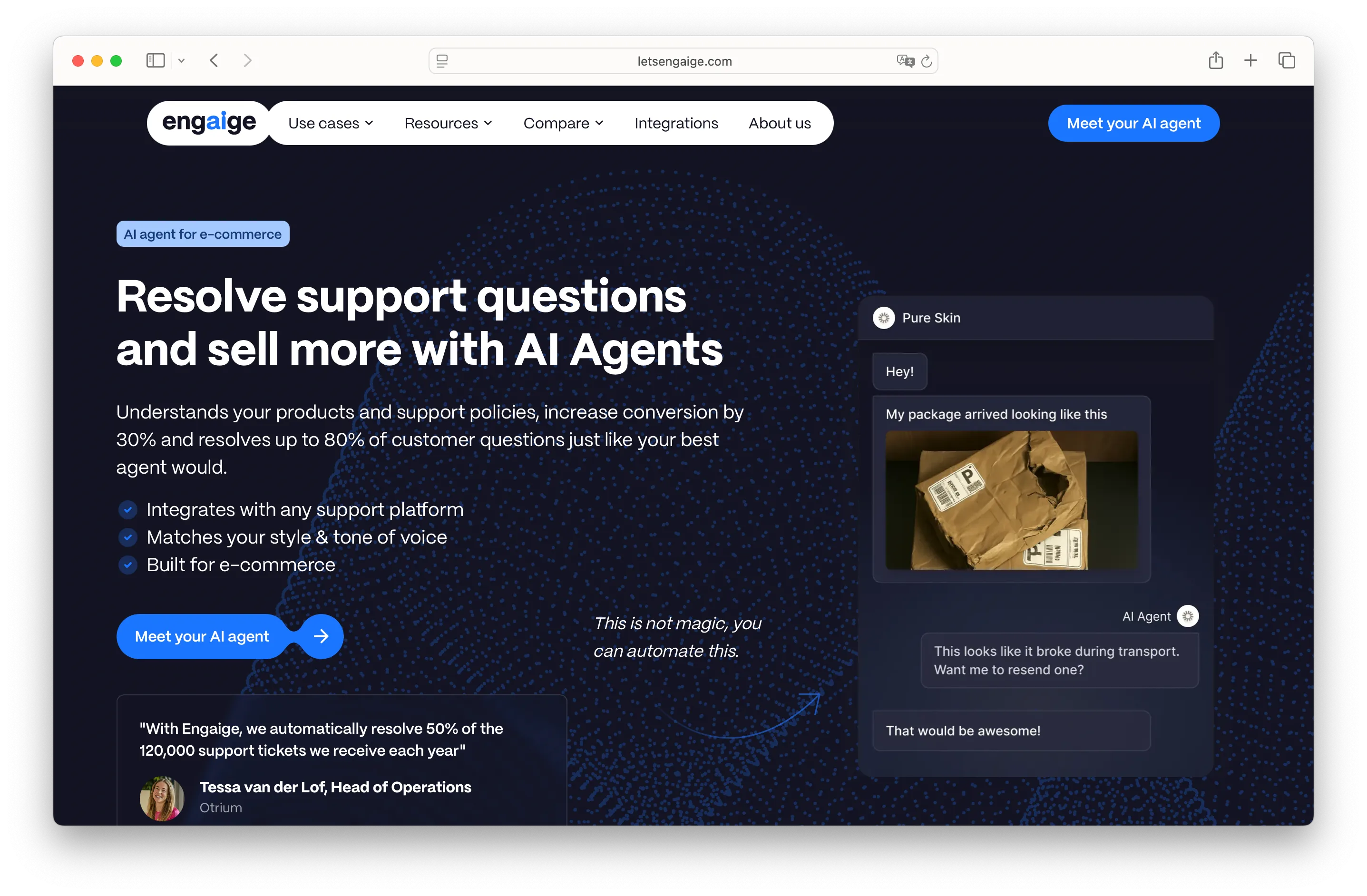
If Gorgias helps you move fast and Zendesk helps you stay organised, at Engaige we focus on something else entirely: reducing how much work reaches your support team in the first place. Instead of routing tickets better or suggesting replies, Engaige is designed to resolve a large share of e-commerce questions end to end.
Engaige works directly with your live Shopify data (i.e. orders, inventory, shipments and policies) so it can handle the repetitive work that dominates most inboxes: WISMO, returns, resends, product questions and subscription changes.
For brands like MR MARVIS, that means over 50% of AI-handled conversations are fully resolved without human intervention, while customers still receive fast personal product advice. And because Engaige follows your actual rules and tone of voice, answers stay consistent across chat, email and social channels without constant supervision. As Coreijn, MR MARVIS’s Automation and Knowledge Specialist, put it: “One thing that impresses me every day is the quality of the product recommendations.”
You don’t need to hard-code workflows or hand over full control on day one. Engaige is rolled out with white-glove onboarding and full visibility into what the AI handles, where it escalates and why. That makes it easier to start small, build confidence and expand automation as your volume grows.
Engaige doesn’t replace Gorgias or Zendesk overnight. Many teams run them alongside Engaige. But when support volume starts outpacing your team, Engaige takes ownership of the work that would otherwise keep piling up.
Ready to scale support without scaling headcount? See how much you could save instantly with Engaige.
FAQs about Gorgias vs Zendesk
Below are answers to the most common questions we hear from e-commerce teams comparing Gorgias and Zendesk, from setup and pricing to where AI actually makes a difference.
What’s the biggest difference between Gorgias and Zendesk’s AI agents?
Gorgias is focused on handling common e-commerce questions quickly, especially for Shopify stores. Zendesk AI is broader and more operational, helping with routing, prioritisation and agent assistance across many channels. The key difference is that both mostly support agents, rather than fully taking work off their plate.
Which platform is best for small or medium-sized online stores?
For most small to mid-sized Shopify brands, Gorgias is the easier starting point. It’s faster to set up, simpler to run, and tailored to everyday e-commerce support. Zendesk usually makes more sense once teams grow larger or operations become more complex.
Do I need technical skills to implement Gorgias’s or Zendesk’s AI agents?
For most small to mid-sized Shopify brands, Gorgias is the easier starting point. It’s faster to set up, simpler to run, and tailored to everyday e-commerce support. Zendesk usually makes more sense once teams grow larger or operations become more complex.
How does pricing differ between Gorgias and Zendesk?
For most small to mid-sized Shopify brands, Gorgias is the easier starting point. It’s faster to set up, simpler to run, and tailored to everyday e-commerce support. Zendesk usually makes more sense once teams grow larger or operations become more complex.
Does Engaige integrate with Gorgias or Zendesk?
Yes. Engaige is designed to work alongside existing helpdesks like Gorgias or Zendesk. Many teams keep their current setup and let Engaige handle the high-volume, repetitive work that would otherwise flood the inbox.
Why would I use Engaige if Gorgias or Zendesk already offer AI?
Gorgias and Zendesk AI are mainly built to help agents work faster by routing tickets, suggesting replies or handling very simple cases. That still means most conversations end up with a human. Engaige is designed to fully resolve repetitive e-commerce questions end to end, which matters once ticket volume grows faster than your team can handle.
Is Engaige harder to set up than Gorgias or Zendesk AI?
No. Engaige is rolled out with white-glove onboarding, so teams don’t need technical skills or long implementation projects. While Zendesk can require significant configuration and Gorgias is more self-serve, Engaige focuses on getting the workflows that matter live quickly with support along the way.
When does Engaige make more sense than upgrading Zendesk or Gorgias?
Engaige makes sense when better routing, dashboards or agent assistance no longer solve the problem. If your inbox keeps growing despite optimising your helpdesk, the issue isn’t organisation, it’s volume. That’s where Engaige helps by reducing the number of tickets that ever need human attention.


