
E-commerce AI is machine learning and language models put to work across an online store: customer support and shopping assistance, product recommendations, search, content, pricing and demand forecasting, and fraud screening. Some comes built into your platform. The rest is added on top, like an AI agent that resolves support tickets and advises shoppers from your store data.
What is e-commerce AI?
E-commerce AI is any machine learning or language model that does a job in your store. There are two families. Predictive machine learning, such as recommendations, fraud scores and forecasts, has run inside platforms for years. Language models, behind content, plain-language search, support agents and shopping assistants, are the newer layer.
Interest is rising quickly. Adobe Analytics measured traffic to US retail sites from generative AI tools up 693.4% year over year between 1 November and 31 December 2025, while noting the base of users remains modest. Salesforce reported that AI and agents drove $67 billion of Cyber Week 2025 sales and influenced 20% of global orders, through product recommendations and conversational customer service. That is Salesforce’s own shopping data.
You do not buy e-commerce AI as one thing. You choose which jobs it does in your store, and whether your platform covers them or you add a specialist. Our guide to AI agents covers the support side in full.
What are the benefits of AI for e-commerce customer support?
The benefits of AI for e-commerce customer support are faster answers at any hour, capacity that stretches at peak without hiring, help in the shopper’s language, consistent answers from live data and fewer hours spent on repeat work. They are the most measurable benefits of e-commerce AI, because every resolved ticket is counted.
| Benefit | What it means for your store | Where it comes from |
|---|---|---|
| 24/7 answers and response speed | Shoppers get a reply at night and at weekends, in seconds | Support agent |
| Volume at peak | Black Friday queues do not need extra hires | Support agent |
| Multilingual help | Replies in the shopper’s own language | Support agent, content tools |
| Fewer errors, consistent voice | The same policy and tone in every reply | Support agent |
| WISMO handled automatically | Order status answered from live order and carrier data | Support agent |
| Personal replies | Answers that use the shopper’s order history | Support agent |
| Product advice before purchase | Questions about size, fit or stock answered while the shopper is deciding | Shopping assistant |
| Team time freed | People handle the hard cases | Support agent |
| Cost that scales slower than orders | Volume grows without a matching rise in headcount | Support agent |
| Insight into why customers contact you | Patterns in contacts show what to fix in the product or the shipping | Support agent |
Language matters more than most stores assume. CSA Research, as reported by Weglot, found that 40% of shoppers would not buy from websites in other languages and 65% are more likely to convert when product information is in their own language.
Three of these show up first:
- WISMO share: LateShipment puts “where is my order” questions at 20 to 40% of support tickets, and 50% or more of the queue at peak. An agent that reads live order data answers them without a person.
- Peak scaling: the agent absorbs the surge, so seasonal peaks and Black Friday stop being a hiring problem.
- Team on the hard cases: HelloPrint automated 80% of tickets, improved first response by 90% and went from 100 to 28 agents.
For numbers on cost, see the ROI guide. We do not invent savings figures here.
What does AI change in e-commerce customer support?
In an online store, AI resolves the order questions that fill the queue, such as WISMO, returns and address changes, against live order data rather than only answering them. Your team handles exceptions, judgement calls and the cases the agent hands back. For the general definition, see our guide to customer support, and for the wider shopper journey, customer experience.
Industry data points the same way. The Salesforce report (6,500 service professionals, 13 November 2025) found teams estimate 30% of cases are handled by AI today and project 50% by 2027. Gartner predicts that by 2029 agentic AI will autonomously resolve 80% of common customer service issues, with a 30% reduction in operational costs. That is a prediction, not a measurement.
In the same Cyber Week 2025 release, Salesforce reported agentic customer service conversations growing 55% week over week, and agent actions such as updating delivery addresses and starting returns rising 70% on the prior week. That is vendor-reported data from its own platform.
A good answer needs several systems at once. A WISMO reply needs the order in the platform, the tracking status at the carrier and the conversation in the help desk. A good agent checks all three before it replies, and shows why it answered, with the source.
Hi, where is my order? It's been eight days and the tracking hasn't moved.

Shopify
Order 48219 · fulfilled

Picqer
Still processing Contradicts Shopify

DHL
Returned to depot · 3 delivery attempts
Settles it: the parcel is not with the customer
Reasoning…
Not deliverable. Reship to a confirmed address, booked in Picqer.
Suggested reply
Your parcel went back to the depot after three delivery attempts, so it will not arrive. I have booked a reshipment to the address you confirmed, arriving Thursday.
On the human side, BPO staffing is a question worth answering before you buy. Which tool to pick is a separate question, covered in our guide to AI chatbots for e-commerce, and an agent comparison explains the difference.
Where else is AI used in an online store?
AI works in seven places in an online store, from the product page to the inbox. Customer support, covered above, is one of them. Most stores already run some of it without noticing, because platforms ship it built in. The table gives one example per type.
| Type | What it does | Example in a store | Often comes from |
|---|---|---|---|
| Product recommendations | Suggests related or personalised products | ”Customers who bought this also bought” on a product page | Platform or a recommendation app |
| Search and discovery | Understands what a shopper means and orders results and filters | Shopify’s Search & Discovery app can sort filter values for storefront filters | Platform or a search tool |
| Content creation | Drafts product descriptions, images and theme text | Shopify Sidekick is an AI assistant in the Shopify admin and can write text in pages you edit | Platform or a content tool |
| Pricing and demand forecasting | Predicts demand and spend so you price and stock ahead | Shopify shows projections for amount spent per customer in the cohort analysis report | Analytics or pricing tools |
| Fraud screening | Scores orders for risk before you fulfil | Shopify rates eligible orders low, medium or high risk using machine learning | Platform or payment provider |
| Customer support | Resolves after-purchase questions and takes the action in your systems | An AI agent working on tickets in your help desk, such as WISMO, returns and address changes | Specialist AI agent |
| Shopping assistant | Advises shoppers before they buy, in a storefront chat | Recommending a size or product from the live catalogue | Platform chat agent or a specialist agent |
The last two rows talk to customers, so they carry the most risk and the most visible upside. Product advice is the pre-sale side of the same agent that handles support.
What is an AI-powered e-commerce platform?
An AI-powered e-commerce platform has AI features built into the admin and storefront, such as content generation, filter sorting, fraud scoring and an in-store chat assistant. It covers the common jobs for one store on one platform. Customer-facing work that spans your help desk, carriers and returns tools usually needs an agent added on top.
Shopify is a concrete picture. Its AI-powered tools page lists Sidekick in the admin, Inbox instant answers and suggested replies, product category suggestions, filter sorting, customer segment descriptions and cohort projections. Shopify says many of these features are available at no additional cost, but availability can vary by plan, device and language.
Its built-in shopping assistant is a real, useful option. The Inbox agent can answer product questions, make personalised recommendations, help with order lookups and add items to a cart. It only operates within your online store’s chat widget, and Shopify notes you are responsible for the accuracy of what it tells customers. The point is scope, not quality.
| Built into the platform | Agent added on top | |
|---|---|---|
| Where it works | Admin and storefront chat widget | Your help desk, email, chat, WhatsApp, SMS and social DMs |
| Data it uses | That platform’s catalogue, policies and pages | Platform data plus help desk, carrier, returns, subscription and custom systems |
| Actions | Platform actions such as cart and order lookup | Actions across connected systems, such as a return label or an address change |
If you are choosing for a specific platform, our guide to Shopify agents goes through the options.
What are the risks and limits of e-commerce AI?
The risks are wrong answers you are liable for, customers who cannot reach a person, decisions that run on bad data, and a black box you cannot correct. Each is manageable with live data, policies that limit what the AI may do alone, visible reasoning and an easy route to your team.
| Risk | What it looks like | How to limit it |
|---|---|---|
| Wrong or invented answers | A promise your policy does not allow | Answer from live data and policies, not guesses |
| Liability | You are held to what the AI said | Limit what it may promise, review its answers |
| Customers who want a person | Shoppers stuck in a loop with no way out | An easy hand-off at every step |
| Stale or partial data | Stock or price wrong in one market | Read live data per market and SKU |
| Opaque decisions | You cannot see why it answered | Show the reasoning and the source |
| Over-automation | Refunds or exceptions without a check | Decide per step what it may do alone |
On liability, in Moffatt v Air Canada (Law360 report, BC Civil Resolution Tribunal, February 2024), the airline’s chatbot gave a customer bereavement-fare information that contradicted its policy. The tribunal held that it made no difference whether the information came from a static page or a chatbot, and awarded CAD 650.88 in damages, CAD 812.02 with interest and tribunal fees. It is a tribunal decision, not a court precedent, and not e-commerce. Take it as the general principle that you own what your AI says.
Customers are wary of AI that blocks them from a person, so the design rule is simple: always keep an easy hand-off. Our AI agents guide has the survey data on what customers fear.
Platforms say the same. Shopify’s own page warns that AI outputs can contain errors, so you should review anything a tool creates or changes. Our view is policy-governed control: you decide per step what the agent may do alone and where a person checks first, and every answer shows why.
October 2026a quick cheat sheet for the bot helped me avoid the biggest mistakes but you still need a human on damage claims · Shopify CommunityHow do you choose e-commerce AI for your store?
Start from the job, not the tool. List where hours go (WISMO, returns, product questions), check what your platform already does, then judge any add-on on resolution, data access, control and how fast it improves after go-live.
- Which systems does it read and act in?
- Does it work inside the help desk you already run?
- Can you see why it answered?
- Do you approve what changes?
- How does it hand off to a person?
- Which channels does it cover?
For vendor choice, see our ranked guide to the top agents. For rollout, the automation guide walks through implementation.
Where does Engaige fit?
Engaige (that’s us) is not a recommendation engine, site search, pricing or marketing tool. It is the support and shopping-assistant part of e-commerce AI: an AI agent that plugs into the help desk you already run, resolves across your stack and keeps improving itself. Engaige AI configures it from your conversations, and you approve the changes. Otrium, for example, has 60% of 120,000 annual tickets resolved end to end with Engaige.
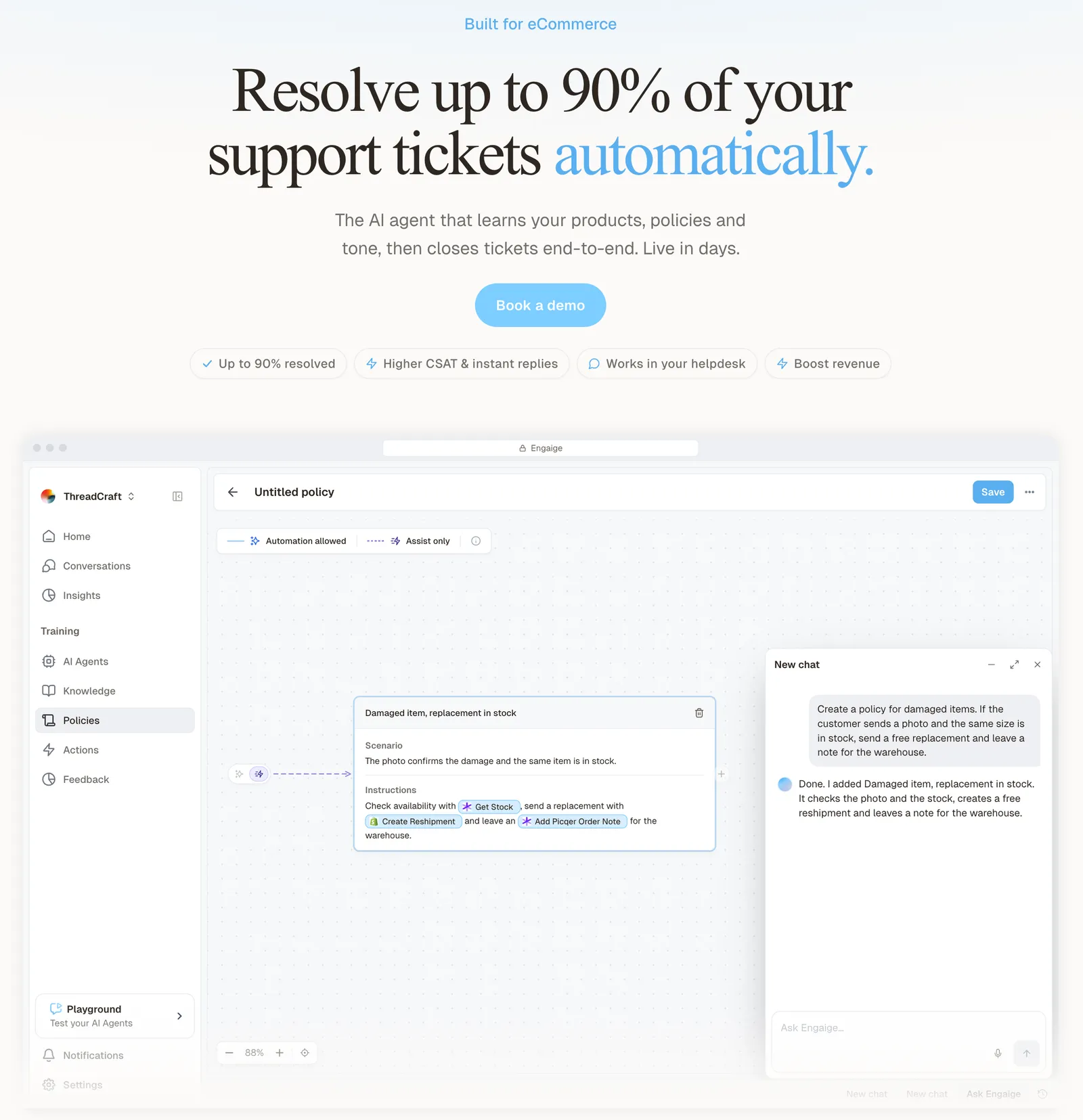
It is one agent with two jobs, from the store’s own data. On Shopify, Engaige combines live Admin API data (pricing across markets and SKUs, inventory, orders and customers) with the marketing content from your storefront. So it has both the exact commerce facts and your brand’s voice, deeper than tools that only scrape. The same agent resolves after purchase and advises before it.
Keep your helpdesk. Replace the AI. Agent Assist drafts replies and suggested actions inside your helpdesk, with no migration. You go live in Agent Assist in hours, and ticket types move to autonomous one at a time.
Engaige AI learns from the difference between what your team sends and what the agent suggested, and you approve each improvement; most brands take ticket types autonomous in about a week, up to 90% of supported tickets. The full loop is in our guide to AI agents.
MR MARVIS, a Shopify Plus brand, handles over 120,000 questions a year with Engaige, resolving over 60% of the conversations it is involved in, with personal product advice around the clock.
The same agent works as an AI shopping assistant in a storefront chat widget. It recommends across the whole collection in your brand’s tone, from live stock and price.
One thing that impresses me every day is the quality of the product recommendations.

Our store chatbots guide covers chatbots for online stores in general.
Engaige is text-first by design: email, chat, WhatsApp, SMS and social DMs, no voice AI. It answers from live store data, your storefront and any docs you add; for what a help centre does on its own, see our guide to knowledge bases.
To see the benefits on your own tickets, book a demo.
Frequently asked questions
What is e-commerce AI?
It is machine learning and language models doing jobs in an online store: recommendations, search, content, pricing and forecasting, fraud screening, customer support and shopping assistance.
How is AI used in e-commerce today?
In seven places. Recommendations, search, content, pricing and forecasting, and fraud screening work in the background on catalogue and order data; customer support and the shopping assistant talk to shoppers directly.
What is an AI-powered e-commerce platform?
A platform with AI built into the admin and storefront, covering common jobs for one store. Work across your help desk, carriers and returns tools usually needs an agent added on top.
What are the benefits of AI for e-commerce support?
Faster answers at any hour, capacity at peak, consistent replies from live data and less repeat work for your team. Resolved tickets make support the most measurable benefit.
Can AI replace an e-commerce support team?
It takes the repeat volume and hands back exceptions. Engaige goes live in Agent Assist in hours and moves ticket types to autonomous one at a time, while your team keeps the judgement calls.
What are the risks of using AI in an online store?
Wrong answers you are liable for, customers who cannot reach a person, stale data and opaque decisions. Live data, policies, visible reasoning and an easy hand-off limit each one.
Can one AI agent handle both support and product advice?
Yes. Engaige is one agent with two jobs, using the Shopify Admin API plus your storefront content. It resolves after purchase and advises before it.
Does e-commerce AI replace my help desk?
No. Keep your help desk. Agent Assist drafts replies and suggested actions inside it, and you do not migrate anything.


